




Onion Address
Overview
Excavator is a search engine designed specifically for the Tor network, allowing users to discover .onion hidden services by keyword without compromising their privacy. Unlike mainstream search engines that monetize user behavior through profiling and targeted advertising, Excavator is built around a fundamentally different premise: people use Tor because they don’t want to be identified, and a search engine serving that network should respect that intent.
Core Philosophy
Mainstream search engines fund themselves by learning who you are — what you search for, what you click, where you go next. On Tor, that business model is contradictory. Excavator exists to fill that gap with a search engine that fits the privacy expectations of the network it serves.
The project’s stance is straightforward:
- No cookies are set on users.
- No fingerprinting or third-party analytics are used.
- No advertising profile is built or sold.
- Queries are not tied to a person.
The only data retained is server-side counts of page views and search terms, used solely to monitor load and identify popular topics.
Technical Architecture
Excavator is deliberately minimalist in its implementation:
- Server-side PHP generates plain HTML for every page.
- No client-side JavaScript — the site works fully with JavaScript disabled, including Tor Browser on its “Safest” setting.
- No CDN assets or externally loaded fonts.
- No cloud providers — the index is kept on hardware the project controls.
This means the page you receive is exactly the page the server sent, with nothing injected or modified by third parties. The entire stack is self-hosted and self-contained.
Own Crawler and Index
Excavator does not pull results from Google, Bing, or any outside API. The project runs its own crawler that visits .onion sites and indexes:
- Page titles
- Descriptions
- Full page text
This independent index ensures that results reflect what’s actually on the Tor network, not what commercial search engines choose to surface (or ignore).
The Excavator Network
Excavator is not a single website but a small network of clearnet entry points, each serving a different function:
| Domain | Purpose |
|---|---|
| excavatorsearch.direct | Main search page — type a keyword, get .onion results |
| excavatorsearch.wiki | Hand-checked directory of .onion sites sorted by category |
| excavatorsearch.info | Plain-language guides on Tor, hidden services, and safety |
| excavatorsearch.click | .onion link shortener for sharing long addresses |
| excavatorsearch.link | Alternate clearnet search address, same index |
| excavatorsearch.website | Project home page with documentation and FAQs |
Tor Address
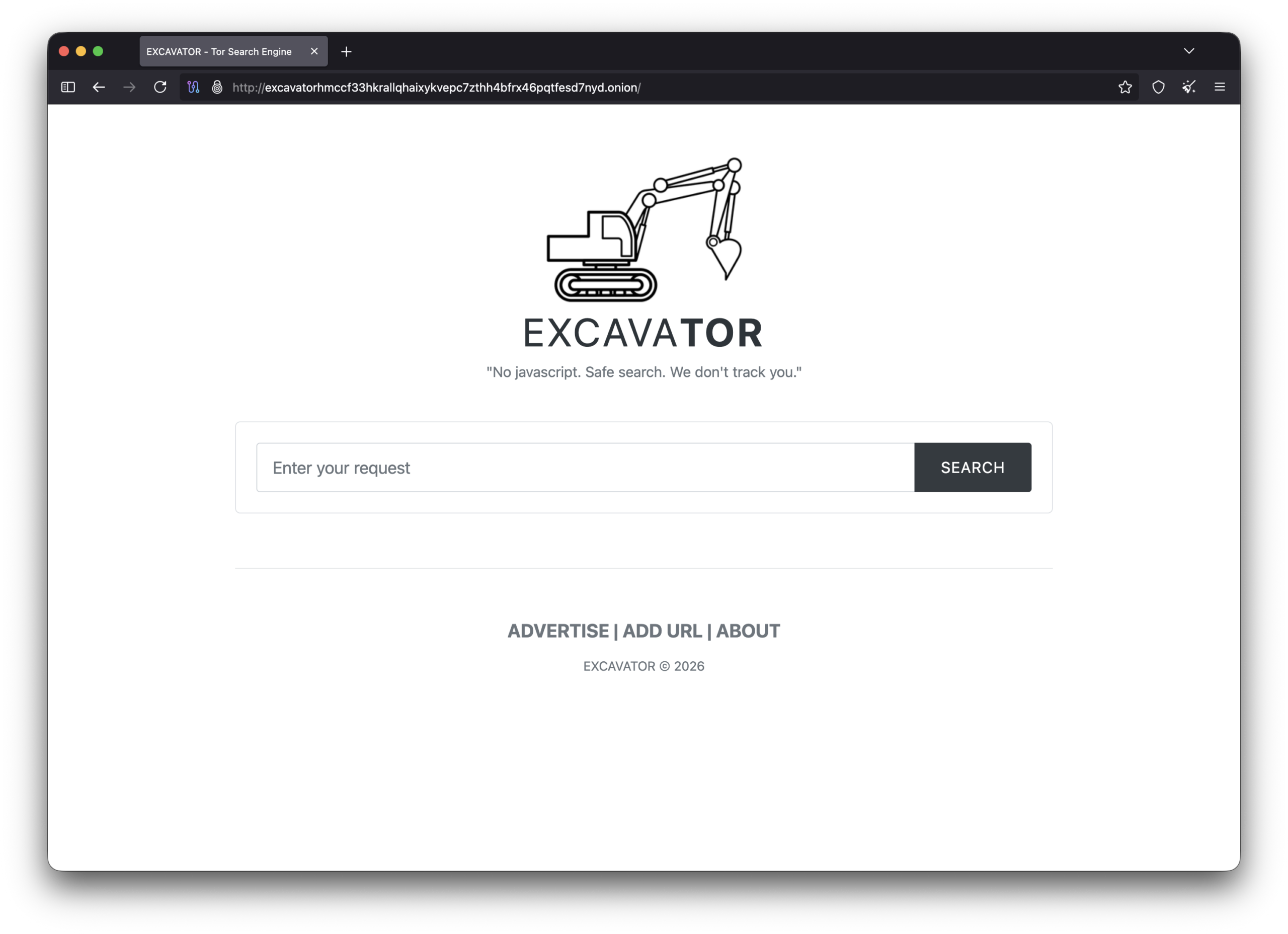
For maximum privacy, Excavator is also accessible directly via its .onion address in Tor Browser:
http://excavatorhmccf33hkrallqhaixykvepc7zthh4bfrx46pqtfesd7nyd.onionThis is the most private way to use the service, as it keeps the entire session within the Tor network.
How Searching Works
- QueryQuery is an online Q&A platform where users can ask questions on any topic and get answers from the community. It features voting, reputation points, and topic tags to organize and highlight quality content. While answer quality can vary, Query aims to provide quick, crowdsourced knowledge and create a collaborative space for sharing expertise. With active moderation and community engagement, it has the potential to become a valuable resource for learning and discussion. More matching — Your search term is matched against titles, descriptions, URLs, and page text in Excavator’s local index.
- Relevance ranking — Results are ordered by relevance to your queryQuery is an online Q&A platform where users can ask questions on any topic and get answers from the community. It features voting, reputation points, and topic tags to organize and highlight quality content. While answer quality can vary, Query aims to provide quick, crowdsourced knowledge and create a collaborative space for sharing expertise. With active moderation and community engagement, it has the potential to become a valuable resource for learning and discussion. More.
- No paid ranking — Organic results are not influenced by payment. Promoted listings, where they exist, are clearly labeled and shown separately from organic results.
Getting Listed
Operators of .onion sites can submit their sites for inclusion via the Add URL page. Key points about the listing process:
- Every submission is reviewed by a person before appearing in results.
- Sites that link to already-indexed pages are often discovered and crawled automatically.
- There is no automated or paid inclusion that bypasses human review.
Advertising
Excavator does accept advertising in two forms:
- Homepage banners
- Clearly labeled promoted listings
All advertising is visually distinguished from organic search results. Pricing and placement details are available on the project’s Advertise page.
Frequently Asked Questions
Do I need Tor Browser to search?
No. The clearnet entry points (such as excavatorsearch.direct) work in any standard browser. However, you will need Tor Browser to actually open the .onion results, and using Tor Browser provides the most private way to interact with Excavator.
What does Excavator record?
Server-side page view counts and search term counts — nothing more. No cookies, no third-party analytics, no user profiles, no data sold to third parties.
How is ranking determined?
Purely by relevance matching against the local index. There is no paid ranking in organic results.
Why Excavator Matters
The Tor network hosts a wide range of services — search portals, email providers, news outlets, tools, forums, and more — but discovering them has always been a challenge. Traditional search engines largely ignore .onion content, and the directories that do exist are often outdated, unmaintained, or themselves compromised.
Excavator addresses this by:
- Running its own crawler to keep the index current
- Providing keyword search rather than just categorical browsing
- Operating with zero user profiling, aligning with Tor’s privacy ethos
- Offering both clearnet and
.onionaccess points - Maintaining a human-reviewed submission process
For users of Tor who want to find hidden services without surrendering their search history to a commercial entity, Excavator offers a rare combination: functional search and genuine privacy.
Contact and Removal Requests
Partnerships, abuse reports, and removal requests are all handled through a single contact form on excavatorsearch.direct. The project states that removal requests for indexed content are prioritized.
Excavator is an independent project. Tor Browser can be downloaded from torproject.org.